Underfloor Heating Commissioning: Why It Matters Before Floor Finishes Go Down
As temperatures drop and sites close up for winter, it is tempting to switch the underfloor heating on and let it get on with it. But turning underfloor heating (UFH) on too early, or too fast, is one of the quickest ways to damage a screed and put your floor finishes programme at risk.
Underfloor heating commissioning is the controlled process of bringing the heating system and the screed up to temperature, and back down again, before floor coverings are installed. Done properly, it protects the screed, proves the system works and helps the floor reach the condition it needs to be in. Done badly, it can lead to cracking, curling and unreliable moisture readings.
What is underfloor heating commissioning?
Commissioning is a staged heat-up and cool-down of a UFH system, carried out once the screed has reached the age and strength set out by the screed manufacturer. Rather than switching the heating straight to full temperature, the flow temperature is raised gradually, held, and then reduced in controlled steps.
The process has two purposes. It checks that the system performs as designed, and it conditions the screed so that it is stable before flooring goes down.
Why does it matter?
Screed reacts to rapid temperature change. Heating it too quickly can cause:
- Cracking and curling, which can be expensive to repair once finishes are in place.
- Surface defects that affect how adhesives and coverings bond.
- Misleading moisture readings, because heat can drive moisture around within the build-up without removing it.
- Programme delays, when problems only show up after floor finishes have been ordered or booked.
Many floor covering and screed manufacturers also expect to see a record that commissioning was carried out and that moisture testing was completed, so good records protect everyone involved.
How a staged heat-up works
Every screed is different, so always follow the screed manufacturer’s data sheet. As a general guide, a controlled process looks like this:
- Wait for the screed to be ready. Calcium sulphate (anhydrite) screeds can typically be commissioned sooner than cement-based screeds, but check the manufacturer’s guidance for your product and thickness.
- Start low. Begin at around 20°C, or the lowest temperature your manifold allows.
- Increase in small steps. Raise the temperature gradually, typically by around 5°C a day, up to the maximum design temperature.
- Hold. Keep the system at the maximum temperature for the period recommended for your screed.
- Step back down. Reduce the temperature in the same controlled increments until you are back at around 20°C.
- Ventilate and dehumidify throughout. Moisture leaving the screed has to go somewhere. Without airflow and dehumidification it simply saturates the air.
Commissioning, force drying and conditioning: what is the difference?
These terms are often used interchangeably, but they are not the same thing:
- Commissioning proves the UFH system works and brings it up to temperature in a controlled way.
- Force drying uses controlled heat, airflow and dehumidification to speed up moisture removal from the screed.
- Conditioning brings the screed to a stable state, ready for moisture testing and floor finishes.
On many projects these run together in a single programme, which is how ForceDry approaches it.
Common mistakes to avoid
- Switching the heating on too early or too high because the programme is tight.
- Heating without dehumidification or ventilation, so moisture has nowhere to go.
- Working in a building that is not watertight, especially in winter, when cold and damp work against the screed.
- Failing to keep records of temperatures, dates and readings.
- Leaving the heating on during a moisture test. For hygrometer testing, UFH should be switched off at least two days beforehand so the screed can cool completely.
What if there is no working boiler?
On many sites the underfloor heating is installed long before the main heating is live. In that situation, specialist temporary electric boilers can be connected to the UFH manifold to carry out commissioning and conditioning, alongside dehumidifiers and air-moving fans to manage the environment.
How ForceDry can help
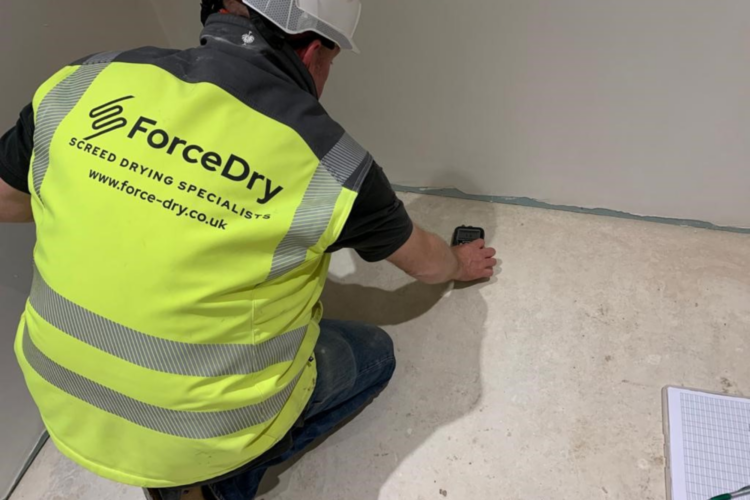
ForceDry’s Commissioning & Conditioning service takes the guesswork out of bringing UFH and screed up to temperature. Our team can plan the process with you around your screed, your building and your programme, and can produce records throughout so you can show the work was done properly.
How long does underfloor heating commissioning take?
It depends on the screed type, brand and thickness. A full ForceDry programme can run over around 21 days, depending on the specification of the screed.
Can underfloor heating be commissioned in winter?
Yes, provided the building is watertight and conditions are controlled with heat, airflow and dehumidification. Winter is when professional support makes the biggest difference.
Is commissioning the same as force drying?
No. Commissioning proves and brings the system up to temperature in a controlled way. Force drying focuses on removing moisture. They are often combined in one programme.
Do I need to switch the heating off before moisture testing?
Yes. For hygrometer testing, heating should be off for at least two days beforehand so the screed has cooled completely.


Related Blog Posts