
How Faster Drying Improves Construction Delivery
Every day saved can reduce overheads, improve cash flow, and enable earlier handovers. However, despite improvements in materials and construction methods, drying and curing periods remain one of the most common causes of delay, particularly in internal finishes and floor construction.
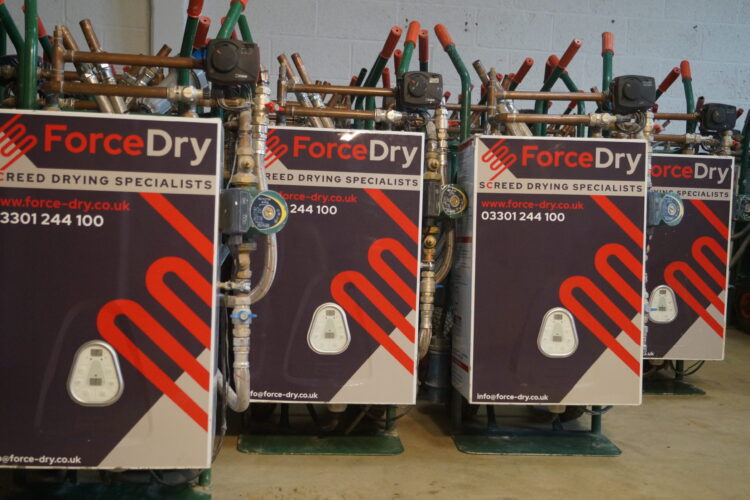
ForceDry is designed to address this exact challenge. By introducing controlled drying environments into the construction programme, it helps contractors reduce waiting times, improve predictability, and regain control over critical path activities. Gaining programme time is no longer just about scheduling efficiency, but about actively managing the conditions that dictate how quickly a building can progress.
The Real Cause of Programme Delays on Site

On paper, construction programmes are carefully planned and sequenced. In reality, drying and curing phases often disrupt that plan.
The issue is that natural drying is highly unpredictable. Temperature, humidity, airflow, building envelope conditions, and seasonal weather all influence how quickly moisture is removed. In the UK climate, these variables often work against programme certainty, even in warmer months.
A screed that is not dry on time can delay floor finishes. This then pushes back joinery, decorating, and final fix works. What begins as a single delay quickly cascades through the programme, affecting multiple trades and compressing later stages of the project.
ForceDry removes much of this uncertainty by turning drying into a controlled, planned process rather than a passive waiting period.
Why Traditional Drying Methods Fall Short
Most construction sites rely on the weather to support drying, where natural ventilation depends entirely on external weather conditions. Opening doors or windows may help in some situations but can also introduce cold air or excess moisture, reducing effectiveness.
The fundamental limitation is that these approaches treat drying as something that happens naturally, rather than something that can be engineered. As a result, programme time becomes vulnerable to external conditions rather than being actively controlled.
ForceDry replaces this reactive approach with a structured drying strategy that is aligned with programme milestones and site sequencing.

How ForceDry Gains Programme Time
ForceDry systems create controlled environments that optimise temperature, humidity, and airflow to accelerate moisture removal. Instead of relying on unpredictable external conditions, the drying process is actively managed and stabilised.
One of the key benefits is predictability. When drying conditions are controlled, programme durations become more reliable. This allows project managers to schedule follow-on trades with greater confidence and reduces the need for excessive contingency built into the programme.
ForceDry also reduces the duration of critical path activities. Internal finishes are often held up by screed drying times, which can extend overall project length significantly. By accelerating this process, earlier access is given to flooring contractors and finishing trades, allowing works to begin sooner.
Another major advantage is improved workflow continuity. Instead of waiting for entire areas to naturally dry, projects can be phased and managed so that different zones are prepared and handed over in sequence. This ensures that labour is not left idle and that progress continues across the site.
In addition, controlled drying reduces the risk of premature installation of finishes onto damp substrates, which can lead to costly failures and rework. Avoiding these issues prevents further programme disruption and protects overall delivery timelines.
Integrating Drying into the Construction Programme
The real value of ForceDry comes from how it is integrated into the construction programme. Drying is no longer treated as downtime but as an active construction phase.
By planning drying zones within the programme, site teams can coordinate works more effectively. One area can be drying while another is being fitted out, ensuring continuous progress across the project.
This zoning approach allows for staggered handovers, where parts of a building are released for follow-on trades as soon as they reach the required moisture levels. It also supports just-in-time scheduling, reducing congestion on site and improving overall coordination between trades.
Rather than extending the programme to accommodate drying uncertainty, ForceDry allows drying to be absorbed into the construction sequence in a structured and controlled way.
The Cost Benefits of Gaining Programme Time
Programme time savings have direct financial benefits. Every day saved on site reduces overhead costs such as management, equipment hire, and temporary services. It also allows contractors to move more quickly onto new projects, improving resource efficiency.
For developers, earlier completion can lead to faster revenue generation and improved return on investment.
ForceDry contributes to these savings by reducing the duration of moisture-dependent activities that typically extend construction programmes unnecessarily.
Turning Drying into a Programme Advantage
Drying and curing are often seen as unavoidable delays in construction, but they do not have to be. By introducing controlled environmental management, ForceDry transforms drying from a passive waiting period into an active, controlled phase of construction.
This shift enables greater predictability, improved sequencing, reduced risk, and most importantly, significant gains in programme time.
In a competitive construction environment where delivery speed and certainty are critical, ForceDry provides a practical way to regain control of the programme and keep projects moving forward efficiently.
Want to find out how we can help?
Get in touch today to speak to the team.
 03301 244 100
 info@force-dry.co.uk
Related Blog Posts